What Should the Christian Believe About the Old Testament?
Witness 1
[Note - some of this material has been posted before. Witness 2 and I run a real-life ministry as well, and the content is often shared. However, there is new material here as well and I thought our readers would find this interesting, informative, and important.]
What should the Christian believe about the Old Testament? How does it affect our lives today, and has the modern church incorrectly given in to the modern-day secular religion of Scientism?
The Old Testament is a major part of the Bible and represents Gods first revelation to humanity. In it, we find the moral and spiritual evolution of humanity over the last 6,000 years. The Old Testament is an incredible text containing fascinating mysteries and books to study, written by approximately 32 different authors over a period of somewhere around 1500 years.
To understand the Old Testament, we can begin by dividing it into sections.
The sections of the Old Testament are:
1. The law, or Torah, also called the Pentateuch, the first five books.
2. The Historical Books, Joshua through Esther, sometimes called the Former Prophets.
3. The Books of Wisdom, including Ecclesiastes, Proverbs, Job, and Song of Solomon, with authorship traditionally credited to King Solomon.
4. The Major Prophets such as Isaiah, Jeremiah, and Daniel.
5. The Minor prophets, like Hosea, Amos, Habakkuk, Zechariah, and others.
To simplify this even further, I like to sub-divide it into three major sections:
- The Prophetic Writings
- The Law, and;
- The Historical Writings
Mainly, I want to focus on the historical writings today, but first I will briefly discuss the other two sections.
The Prophetic Writings
According to Grant Jeffery in The Signature of God:
- The Bible contains 1,817 individual predictions concerning 737 separate subjects found in 8,352 verses. These predictions comprise 27 percent of the 31,124 verses in the whole of the Scriptures.
Amazingly, not a single one of these prophecies can be shown to be false. They have all either come true or are in the process of coming true currently. The Bible represents the only, singular time that humanity has ever experienced accurate predictions of the future, and thus, is the only religious text that presents a conclusive case for veracity and supernatural authorship.
Some of these prophecies include Daniel’s predictions of future kingdoms, Messianic prophecies about the life, death, and resurrection of Jesus, and specific prophecies about the exact way the enemies of the Israelites would be destroyed, like the cities of Tyre and Jericho, along the nation of Edom. King Cyrus was also predicted by name by the prophet Isaiah around 100 years before he was ruler. In The More Rational Worldview, I cover these in greater detail beginning on page 299.
The Law
For those following along, you will recall my four solae post the other week. In it, I did not mention that following the law was required for Christian Salvation. This is a key part of Christian doctrine – we are no longer under the law as Jesus Christ fulfilled it.
A parable to study in this regard is the parable of the old and new wineskins, in which Jesus tells us not to put old wine, the old law, into new wineskins, the new, budding religion of Christianity. In fact, this is why the power structures hated both Jesus and Paul so much – they were saying that the ruling authorities and the Law of the Torah had no more power or authority, because it was fulfilled through Jesus Christ. This is a basic, well-understood, and fully fleshed out Christian doctrine. Jesus fulfilled the law in four ways:
- Jesus fulfilled the doctrinal teachings of the Law and the Prophets in that He brought full revelation.
- Jesus fulfilled the predictive prophecy of the Law and the Prophets in that He is the Promised One, showing the reality behind the shadows.
- Jesus fulfilled the moral and legal demands of the Law and the Prophets in that He fully obeyed them and He reinterpreted them in their truth.
- Jesus fulfilled the penalty of the Law and the Prophets for us by His death on the cross, taking the penalty we deserved.
Galatians 3: 10 reads:
- For all who rely on the works of the law are under a curse.
Romans 10: 4 reads:
- For Christ is the end of the law for righteousness to everyone who believes.
Romans 3: 28 reads:
- For we maintain that a person is justified by faith apart from the works of the law.
- We have been released from the law so that we serve in the new way of the Spirit, and not in the old way of the written code.
And finally, in 1 Corinthians 9, Paul clarifies explicitly in verse 20 that “I, myself, am not under the law”.
This doctrine of Christians not being under the old law is not a controversial one; rather, it is a widely understood and universally accepted fact within Christian theology. Those who affirm or believe in both the Old Law and Jesus Christ are called Messianic Jews.
The “Enduring Word” Biblical commentary tells us in no uncertain terms on the subject of Jesus fulfilling the law that, and I quote, “The Christian is done with the law as a means of gaining a righteous standing before God.”
However, this is not the main point of my writing today, and I don’t want to get distracted by this.
My main point today is about the historical aspect of the Old Testament. Unlike the law, I believe that Christians do have certain obligations on what to believe here. Jesus was the “word made flesh”, and having faith in the Bible’s narrative is a key component to being a Christian.
Many modern churches and Christians today display an extreme cognitive dissonance that leads to incorrect doctrine and beliefs. For example, many Christians and churches say incorrect things like:
- Well, Noah’s Ark is just a story about a local flood, probably when the Mediterranean spilled over and formed the Black Sea in 5600 B.C.
- Well, Moses probably existed, but the Plagues were just a confluence of natural phenomena
- Well, the Tower of Babel was real, but it’s not the origin of all languages today and it wasn’t destroyed supernaturally by God
- Sodom and Gomorrah existed, but they were probably just hit by a meteor and over time the story became what we read in the Bible
These statments directly contradict the Bible. Most importantly, we often hear:
- Genesis is just an allegory, and God created life through evolution.
Now, I want to be clear here. If you don’t affirm the truth of the historical Old Testament narrative, this is a major doctrinal error that could potentially put your salvation at risk. These lukewarm Christians who deny the historical events given in the Old Testament are making a critical error, and are putting their faith in Science, man, and the world over God.
There’s plenty of good archeological evidence to believe in these events, like the Exodus, Tower of Babel, the Flood, and more, and I also covered that in my book starting on page 278. For today, however, I want to focus on Genesis.
If you go into American churches and poll the people there, you will likely find that most people are very weak in their stance on the historical Genesis. Most have fully succumbed to the deceptions and delusions of modern science – that everything came from nothing, abiogenesis spontaneously formed life from some kind of primordial ooze, and this ancient life that came from non-living substances somehow developed complex DNA codes and then evolved and diversified into the wide variety of organisms we see today through the mysterious and unproven doctrine of evolution. Needless to say, these beliefs are simply absurd.
Presented to young minds in schools as infallible doctrine, this un-special creation of mankind through billions of years of trial and error has become the de facto state religion of the modern world, enforced zealously through institutional power and close social scrutiny. “Oh, I’m not one of those Christians! Of course I believe in evolution.”
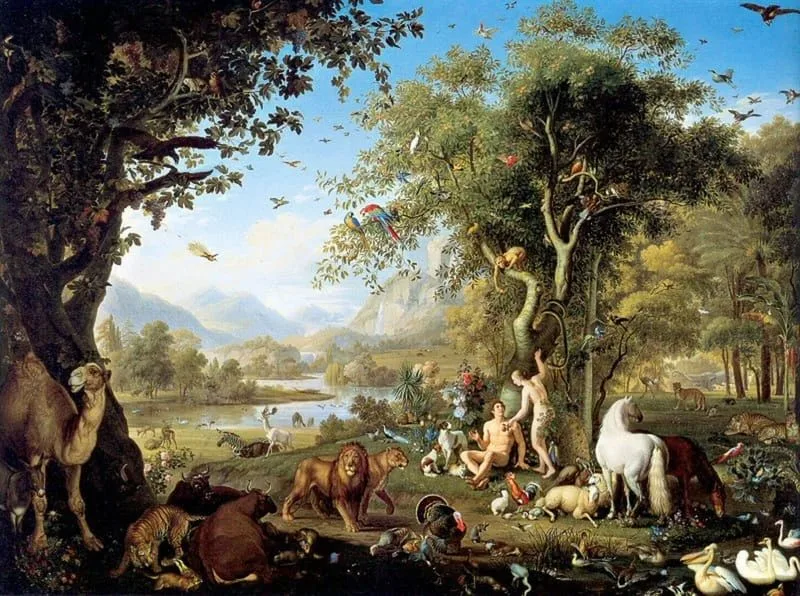
The Bible tells us that Adam was created approximately 6,000 years ago. There’s a few different interpretations of Genesis, one notable one being the “gap theory”, which postulates an ancient universe without life, which could have potentially existed for billions of years.
However, I’m not willing to concede an ancient universe, though I will admit that there is some evidence for it. The more important doctrine to focus on is that the Christian is obligated, at the very least, to believe in the special, purposeful creation of life about 6,000 years ago as described in Genesis. Both Paul and Jesus reference Noah’s flood, Adam, and other narratives of the historical Old Testament as describing real, historical people and events, and to deny these stories is to deny them.
Genesis and evolution are not compatible. You cannot believe in the Bible and also believe in evolution. For example, the Bible tells us that death first entered the world through Adam’s sin, while evolution requires hundreds of millions, or even billions of years of countless organisms dying to produce humanity. Genesis is key within the Bible, and without it being literal, many other thematic elements within it, like Jesus’ sacrifice for this original sin, are weakened. The scientific universe takes humanity out of its place given in the Bible as a moral actor, above the animals, and lowers him down to be one of them.
This Godless universe is monstrous, a morally relative playground for bad actors to manipulate and abuse others seemingly at will. Without justice on a cosmic scale, the physical universe we inhabit is a feverish madhouse of suffering on an incomprehensible scale, a world where death, forgetfulness, and suffering reign supreme, marching ever onward in time with no regard for the living, sentient beings it leaves in its wake, and no hope of ever finding completion, redemption, or peace.
Humanity without God is a universal homeless man, a wanderer forever doomed to obscurity and his iniquities. Our legacy will be one of plastic, pollution, forever chemicals, oil, blood, and war. Never in human history has there ever been an era where we were able to stop killing each other systematically through warfare. The fruits of the scientific worldview, in which mankind is viewed as just a transient, animal guest on a billions of years old planet, can be seen all around us - 10,000 children dying of starvation daily, global wealth equivalent to half the world’s population coagulated into the hands of only eight people, and socio-political frameworks collapsing in front of our very eyes.
Without the Bible's statements on the value of the human soul, mankind retains all the dignity of a beast of burden on a farm with cruel owners, destined to slave forever - sacrificing our very bodies and souls in monumental efforts to create more wealth for a tiny number of deluded sociopaths who already have more wealth than they could ever spend in 100 lifetimes.
Without God, there will be no revolution on the farm - the animals will continue to be slaughtered at will. Only Jesus Christ is the Good Shepherd who is qualified, capable, and entitled to bring us into salvation.
There exists an unavoidable dichotomy staring humanity in the face, and at a certain point, you have to choose what you believe.
Scientists tell us that humanity is merely inhabiting a brief speck of time in a sea of vast nothingness, staring down eons of absolute emptiness, a universe doomed to meaninglessness forever. The intellectual authorities of Earth assure us that nothing will matter in the end, that our planet, and each of us individually, are doomed to inevitable destruction in a universe that will carry on without notice for billions of years after we are gone, likely extinguishing itself in a cold, dark heat death, where all matter is too still and silent to ever permit life again.
On the other hand, the Bible promises us that before humanity is extinguished, God will open the heavens and conduct the events of Judgement Day before the Great White Throne, where every single thought we had, word we spoke, and action we took is meticulously recorded, containing monumental, eternal significance and consequences.
Under a scientific, atheistic worldview, nothing mankind can ever do could end the universe; on the other, mankind is the only thing that ever mattered in the universe. Only time will tell which ending comes true, and only you can choose what you believe.
The shining example of the incompatibility of Genesis and evolution in the creation story is this: which came first – the sun, or plants? Well, any scientist will scoff and assure you that there could be no plants or vegetation without a sun to power their photosynthesis.
However, the Bible tells us in Genesis 1 that plants were created on the third day of creation, while the sun was created on the fourth day. I believe that God did this on purpose, to force the Christian to make a choice – either Genesis is correct, or the scientists are. Who do you choose to believe?