The Final Hour For Preparation & Sermon From Witness 1
This is a warning message from Witness 2 based off of a prophetic dream, a comforting message of hope in this post, as well as a short message about animals in Heaven.
There is also a sermon from Witness 1 about Paul the Apostle after the dream. Thank you!


I'm happiest in my dreamscape with Witness 1, awaiting the beauties and the actualization of my dreams in Heaven. This is Witness 1 and I in the astral realm. : ) Haha, this is what comforts me - please don't make fun of me. : )
Introduction - Dream
The last few nights, I have been awoken by the glow of the Moon, and I have no idea why. I'm a pretty deep sleeper, and I never wake up unless I feel God wants me to wake up. I usually never see the Moon from my perspective in bed, but without even moving, I could see its full, orange glow. The April Moon is actually called the Pink Moon, which reminds me of this lovely but sorrowful song by Nick Drake. However, though the Moon looked much more orange than pink, it was still quite breathtaking.
The first time I was awoken by this Moon, I screamed and woke up Witness 1. He had no idea what was going on, but he comforted me. The second time it happened, I was less scared. Then it happened last night, and I felt at peace.
Again, the Moon was not pink but orange, and I believe this is a reminder that an orange and green haze is coming over this nation, with orange representing purification and power, but also a grand delusion with Trump.
I went back to bed after thinking about the Moon and then God sent me a dream. In the dream, I had some type of supernatural understanding.
I understood that the time to prepare was coming to an end. I was getting everything in order. The dream felt realistic, like it was in the near future, in the month of May 2024 based on personal details.
In the dream, I was reflecting about how my dad never came to our prayer meetings, and how many people were still lost. I thought, "If he had come to just one..."
I was then walking through the desert, and I saw a water source emerge out of nowhere. I thought, "Wow - I've never seen that before! This will be useful soon."
It reminded me of this verse:
- Water will gush forth in the wilderness and streams in the desert. The burning sand will become a pool, the thirsty ground bubbling springs. In the haunts where jackals once lay, grass and reeds and papyrus will grow. And a highway will be there; it will be called the Way of Holiness.

Honestly, what a profound and amazing verse. I could write a whole other post on it!
Moving on, I was at work but everyone seemed off. There was a slight nervous tension. It felt like we all knew something was off - we were all somewhat distracted.
Then, I went to go to the post office. I had to make a payment of $70 on a debt I had. I went into the post office and the lady at the post office was like dead inside. She honestly seemed completely miserable.
For a moment, she took interest in what I was doing, but then she went back to her dead, dark demeanor.
I woke up.
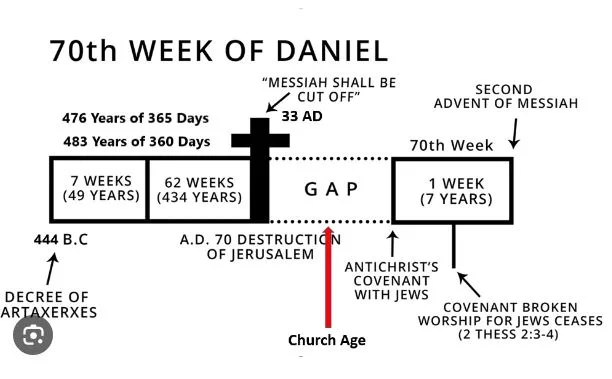
Note: I am not sure how accurate this chart is - I need to study it more.
The Last Hour of Preparation
I, of course, prayed after receiving this dream and sent it to Drew for understanding. I will include my interpretation first.
We are in the last week of Daniel's 70th week. We are in the final hour to prepare.
I had a deep knowledge and understanding in the dream that this was it. Whatever preparations you need to make, make them now.
Of course, that doesn't mean that everything is going to happen over night, but when things happen, it will be hard to stock up and get supplies. It won't be like it is now, where we have much in abundance. This is the time to prepare.
I would use the month of May to get your house in order.
Next, the water source is significant. For those who have taken the past few years to get right with God, they will be protected. God is showing me (and others truly following Him), that He will make a way even in the desert.
I also believe our ministry will represent the "Way of Holiness", and I pray people heed our advice. I believe we will be like water in a stark desert of godlessness and false beliefs.
Next, the situation at the post office is another representation of people becoming monstrous. We will see elements of humanity in them, but this will be harder to find. Let us continue to pray for the lost.
I also believe a transformation is going to happen for those who refuse to repent for taking the abomination of desolation. While I believe there is always hope, many hearts will grow cold.
I won't lose hope. I believe the spring of water in the dream indicates that God can do anything, even in the driest of deserts. This is partly about physical preparation but also about spiritual preparation. I believe our ministry holds the Living Water that many will need so desperately in the coming times, and God can do anything He wants even in the darkest of times. However, this is your call to come back to Him and strive for righteousness in these dark times, as it will be your shield.
I believe God woke me up to the Moon to remind me of the first blog post on this website I made about "eating the Moon", which will be discussed in a moment.
I sent a more detailed dream to Drew, and here is his interpretation, with some personal details omitted.
Drew's Deeper Interpretation
Thank you for the dream/moon observations, I'll try my best to interpret them or give meaning to them where possible.
Starting with the moon, while I have no clear meaning I did notice the following. The last full moon occurred on the 23rd. The last three nights have all been on nights where the percentage of the moon's luminosity has been less than 100%. I would have to assume, since you have said the last three nights, that the first time this happened was on the night of the 25th going into the morning of the 26th, and then the night of the 26th and then last night as well (since by our modern standards we have not had a night today). If you look ahead, or on a physical calendar (most have the phases of the moon on them), the next new moon is slated to happen on the 8th of May, a day after the 7th where we both think something is going to happen, whether it be spiritual or physical or some combination of the two. Either way, the month of May is probably going to have huge happenings (though they will probably seem small).
Continuing on with the moon theme, new moons in some spiritual world views represent a new beginning, a fresh start if you will. I would not find it strange if a new "cycle" starts on the 8th, that the time of "peace" that we are in ends and as you have been saying things start to get bad(er). Also another funny thing I noted after pulling up the moon blog post of yours (it was your first one on this website lol) is that you mentioned that something might be coming in February as a caption on the picture of a full moon. Well, if we instead of February think "second month", then let us remember that Passover occurred on the 22nd (last Monday), which is also the 14th day of the first month in the Hebrew holy calendar. If this is the case, then 14 days later puts us on the 6th of May by our modern calendar. Hmm, nothing strange about that. This would also mean if something does happen that there is a precedent for you having and giving prophecies a year in advance so that might help to explain the whole Nov 3rd (11/3) meaning, maybe it is referring to 3/11 but we were looking at the wrong calendar.
Also for the symbolism of you eating the moon in that one (thank God that He is helping me write this) if we consider that the act of eating something is used in Genesis with the 7 fat cows and then 7 fallow cows, and that the 7 thin and weak cows ate up the 7 fat ones, it could mean something along those lines. Also when you eat something you are in effect destroying it too right? Maybe the moon won't come back again and will stay dark for an extended period of time? Also 16 days from the 7th or 8th puts us at either the 31st of May or the 1st of June, I think the 1st of June is the more likely bet here since we are going by the shape of the moon.
Let me start thinking about your dreams now and see what I can come up with (A.K.A what God decides to reveal to me lol).
It makes sense that you sense that the time of preparation is over, especially with the whole moon stuff going on. Getting things in order is good, personally I think this is simply a sign that you are on the right track as it were. And frankly that all that we can do, prepare and continue to prepare as we see the opportunity, even if the big window is closed, there is always time to do things akin to what we have been.
Again I'm sure that this is pretty cut and dry as to what it means. The first part is that people are either refusing to listen, or they listen, but just don't care. A spirit of spiritual death if you will has fallen over people, or a spirit of slumber has fallen over them. The sleeping powder if you will. They are awake, but cannot see, hearing but cannot hear the spiritual truths that you are giving because they are spiritually dead on the inside, rotten to the core.
The second part is both literal and figurative I think. Where God will take care of His beloved church, that He will provide everything, even in the most impossible of places He is preparing the way for them. A highway is being stood up as it was stated in Isaiah, a way for His people is being prepared to guide then and lead them to the New Jerusalem through the wasteland that we call this world. I do believe that there is going to be spring of fresh (if not living) water springing up in both real deserts, with Oasis watering and littering dry and thirsty lands (where there was no water lol), and in the places where Jesus has either not been preached before, or in places that the word has not been able to gain hold of. It is a great thing! And you get to lead it!
I do think that the last line is just a continuation of the first. People just don't care. The spiritual death or slumber that they are facing or going through, while not impacting them too much, is starting to manifest in the physical. More on this with the post office meeting.
Now let us examine the number 70. I also took a look in the concordance and it is interesting. Sleeplessness and disk. If we also consider it to be 70 days, and not weeks we come to the date of July first from Passover. However if we take it from May 7th we come to July 16th. Maybe it is pointing to something happening on those dates? There are also a lot of references to the number 70 throughout the old testament. Like tons. Here is a link to them all. Some of them reference the age at which Abraham's father Terah gave birth to him and his brothers, others in the NLT are the measurement in feet of the temple as shown in Ezekiel. From the NT we find them all referencing specific verses from the four gospels having to do with Jesus and God His Father either having done an action or a prophecy given by one of the prophets or Jesus being fulfilled in some way. We also have the reference to the 70 disciples that Jesus sent out in pairs (so 35 groups) to do things (like heal the sick and cast out demons). We also have the 70 horsemen in Acts 23:23.

Looking back at the OT, we find that when Jacob went down into Egypt there were 70 people who went down into Egypt total. Gideon had 70 sons. The number of shekels of silver in the silver basins donated in numbers to the construction of the Tabernacle was 70 shekels. There were 70 leaders summoned by Moses to the Tabernacle in Numbers, the same number went up Mount Sinai in Exodus.
There seems to be a connection to the number seventy having to do with God's design of things from what I gather. It is the concept of the perfect number of things needed to fulfil God's will it seems. Or it is some other universal constant. 70 is 7 multiplied by 10. Psalm 70 is all about petitioning God to deliver the psalmist and the believer from his enemy, and to not delay the deliverance. In fact Judah went into captivity in Babylon for 70 years too. There is something about the number that God loves, and we know He loves to use numbers.
"The number 70 represents rest. The salvation of the many depends on the rest in Me. I give rest to those who trust in Me. I am the rest that never ends, the perfect peace of salvation depends on Me. I am the God of Salvation, the God of abundant rest. There is nothing less then 70 times 7 chances of repentance in a person's life, and I will show them everything that they have ever done wrong through this judgment. The 70 years of forgiveness is at its end, now come the 70th week of Judgment to this nation. I will blow out the candle light in this world. I will show the 70th week of Salvation to everyone on Judgment day. The time is fast approaching where rest will be available to all who trust in me. Just be ready, for I come back sooner, far sooner than anyone will ever think."
I also agree that we are in the last couple of weeks of "peace" as things start to heat up as we head into summer. Summer is a hot month, and also a great time to start wars since the ground is not going to be soft, and people are not historically needed to be out in the fields harvesting the crop. Causing depression (both economic and emotional) during the time of year where people are usually the happiest is a great way to make a bad time worse, especially if people start losing their homes.
Thank you, Drew, for the interpretation. I do think you covered it more deeply than I could, and I believe it will give readers something to think about! I believe a great transition like never before is coming, starting in May, accelerating from July and on.
Finally, one part of the dream involved a dog we truly loved, who Witness 1 and I believe was brutally murdered as an attack on us before we started the website but soon after The More Rational Worldview was published. This is a long story and perhaps we will testify upon it one day. I pray for justice in this situation and fire upon anyone who tries to even attempt to harm us in any way, shape, or form in Jesus's name.
Despite this tragedy, I believe God wanted me to tell readers that our pets will be in Heaven, too.
While we don't know all the details, there is nothing in Scripture that goes against this thought - that we will see our pets in Heaven.
Let us all look to Heaven. The days are going to be hard, and I think that the time for preparation is coming to a close.
I believe prophecy is amplifying, and what has been written in this blog will come to pass. This morning, Jake sent me another message that "blood" is coming, and I am in full 100% agreement.
I ask readers to go to Jesus Christ and ask, "Are they writing the truth?" Pray this:
"I pray against all false spirits in Jesus's name. Jesus Christ, are these witnesses sharing the truth in this blog? Please show me."
He will reveal to you.
In the meantime, I'm looking forward to seeing my dogs in Heaven again one day...

Now, let us go to Witness 1's sermon:
Witness 1's Sermon
Note from Witness 1: This is a "milk" sermon I gave in our real-life ministry, to people who don't usually have the great breadth and depth of knowledge as those of us who are lucky enough to have great educations and reliable internet access in our primary language.
It's nothing revolutionary or really even controversial, just a nice little overview and recap of the Apostle Paul, his life, and teachings. Although, of course, we focus on Jesus Christ, Witness 2 and I can both relate to Paul a lot, in that he faced a lot of adversity and persecution.
Even today, there are many scholars who impugn and question Paul, trying to relegate him as author to only a few of the epistles, coming up with the usual ridiculous theories of forgery and interpolation, just like they do with Isaiah, the Gospels, and so much more of the Bible, even historians like Josephus.
Apparently, the idea that an ancient document was written by the claimed and attributed author is too much for them to handle, and there always has to be a way to say, "It's not that special".
The absolute blasphemy Christians show when they say that the 14 books written by Paul should be disregarded, and the arrogance of so-called "scholars" to say that they have the authority to claim that they weren't written by Paul! It boggles the mind that people even come to these conclusions, and false doctrine and ideas like these must be corrected.
Perhaps one day, I will write a defense of the eponymous authorship of the Gospels. However, I think it's simply extraordinary that every other text can be assumed to be written by whoever we always thought wrote it - except, of course, for the Bible. There always has to be something wrong with the Bible.
That's why Witness 2 and I like to defend Paul. No, he's not the Messiah, no one should worship him, but he gets a bum deal a lot of the time, and in his life and up until the present day faces vast criticism and people who just love to tear him apart.
We hope that Paul smiles down from heaven on our defenses of him and his extraordinary life. For more on our defense of Paul and some rebuttals to the usual arguments given against him, find the .PDF on the bottom of our site titled, "In Defense of the Apostle Paul".
I hope that those who read this enjoy it, and find it an interesting and enlightening story. Though our readers likely know this story, I tried to present it in a narrative format that can elucidate just how unusual the sea change that came over Saul/Paul was in history.
Almost nowhere else in the world do we find someone who changed their mind so completely and so instantly, and all natural explanations for this change fail, as I talk about more in the document I referenced above. The only real way to explain the dramatic transformation of Saul into Paul is through a legitimate supernatural experience in which God personally commissioned him to spread the Gospel to the Gentiles.
I want to thank all of our supporters and those who help this ministry keep going. We couldn't do it without you, and through you, we have been able to carry out great work in building God's kingdom here on Earth and providing a ministry with raw, unfiltered truth presented to those who need it the most.
Keep up the good work, tent-makers, and carry on to finish the race strong.
May God bless you all.
-Witness 1
The Story of Paul: A Worker to the End
Approximately five years after Jesus was born, a few hundred miles north of Bethlehem, the second-most important character of the last two millennia was born – not the most important, but another who would change the course of history forever.
He did this not by living out the Messiah’s story of life, death, resurrection, and salvation, but by telling it in a new way to those who never expected to hear it and who would not have understood it. His life did not precipitate the advent of a new calendar, his death did not split the temple curtain in two, and he did not rise again after being killed, but his impact on the world revolutionized theology and the way we would conceptualize God forever.
In time, this second-greatest baby boy of the first century would become one of the most influential, inspiring, and inciting men of his century, who along with Jesus, catalyzed an unprecedented societal and cultural revolution in his day.
Saul was born in Tarsus to the tribe of Benjamin, no doubt named after one of the most famous Jews of antiquity – Saul of Gibeah – a torn and divided man who went from being God’s favored kind to a murderous maniac who would stop at nothing to kill those who stood in his way.
Saul of Tarsus also presents a divided and torn character, seeking to remedy what his namesake set in motion all those years ago, except this time the shift goes from evil to good, from darkness to light, from murderous rage to an all-encompassing love and wisdom.
Tarsus, of modern-day Turkey, was conquered by Rome some 70 years before Saul was born. Being born to landowners, this granted Saul the coveted status of a Roman citizen, afforded privilege and wealth while being allowed to retain his cultural heritage.
Tarsus, as the capital of Cilicia, was a great hub of wealth, trade, and knowledge. It was home to one of the greatest universities in the world at the time, second only to Athens and hosting a personal tutor to emperor Augustus. It was the famed meeting place of Cleopatra and Mark Antony – surely, a culturally great city with few equals in the ancient world.
Now, while Saul was born in Tarsus and spent many influential years there, he was also raised in Jerusalem. While he was a tent-maker by trade (tents, of course, being very important to the Jewish people due to their nomadic desert history and the legacy of the Tabernacle, or tent of meeting where the Ark was kept during the desert wandering) and learned this through his father, he also had the immense privilege of studying under the legendary Pharisee Gamaliel.
Now, Gamaliel was no ordinary pharisee – he is, to this day, considered one of the most knowledgeable Rabbis and master teachers that has ever lived, and to study under him would be like being an assistant to the Einstein of the day.
Gamaliel taught Paul, a pharisee of pharisees, how to apply the law to contemporary social issues, how to interpret the law, and how to use the law to increase wealth, happiness, and satisfaction with life.
Paul, basically, had it made.
The pharisees were considered, at the time, a liberal and middle-class sect of first-century Jews, a reaction to the elitist Sadducees and scribes of their day.
Roughly 10 Pharisees were selected to sit on the highest council of Jerusalem, called the Sanhedrin. The Sanhedrin held the most power in all of Judaism and included members from different sects as well as the high priest. What the Sanhedrin passed into law became the law for all of Judaism.
So, Paul studies under Gamaliel for some eight years before returning to Tarsus for service in the local synagogue as a respected teacher and leader. This, then, is when Paul gets the message of a lifetime – the first one, that is.
He gets a message from Gamaliel that he has been elected to sit on the Sanhedrin council. He makes his way back from Tarsus to Jerusalem, but when he returns, he finds that the city has changed dramatically.
A radical new sect has arisen that has taken the capital of Judaism by storm and incited a major rebellion against the powers that be. They follow a man from Nazareth that had claimed to be God himself, incarnated in the flesh, fulfilling the very prophecies that Saul knew so well.
They called themselves “The Way”, as if the Sanhedrin were incapable of providing the way, the truth, and the light, themselves. Blasphemy!
Saul refuses to dignify them with a name, calling them simply “The Nazarenes”, essentially, “the rabble from the meaningless backwater of Nazareth”. Saul begins his persecution of these zealous, misguided blasphemers with all the fire and zeal of someone born into privilege, educated, and 100% sure of himself and his beliefs.
He begins to question these early followers – simple fishermen and laborers, tax collectors, prostitutes – the lowest of the low! And they dare to challenge his authority, bestowed by the great Gamaliel himself.
Saul and the Sanhedrin charge them strictly, under pain of death and imprisonment, not to share the message that this Nazarene is the messiah, but they don’t listen.
Saul and his men capture one of these followers, a man named Stephen.
In Acts 7, Stephen gives a long, impassioned speech to the Pharisees, ending it with:
- You stiff-necked people, uncircumcised in heart and ears, you always resist the Holy Spirit. As your fathers did, so do you. Which of the prophets did your fathers not persecute? And they killed those who announced beforehand the coming of the Righteous One, whom you have now betrayed and murdered, you who received the law as delivered by angels and did not keep it.
Acts 7 goes on to read:
- The Stoning of Stephen
- Now when they heard these things they were enraged, and they ground their teeth at him. But he, full of the Holy Spirit, gazed into heaven and saw the glory of God, and Jesus standing at the right hand of God. And he said, “Behold, I see the heavens opened, and the Son of Man standing at the right hand of God.” But they cried out with a loud voice and stopped their ears and rushed together at him. Then they cast him out of the city and stoned him. And the witnesses laid down their garments at the feet of a young man named Saul. And as they were stoning Stephen, he called out, “Lord Jesus, receive my spirit.” And falling to his knees he cried out with a loud voice, “Lord, do not hold this sin against them.” And when he had said this, he died.
In this scene we find Saul watching and participating in a cold-blooded murder of the first Christian martyr, Stephen. A grim scene, to be sure, yet Saul remains firm and unshaken in his conviction, 100% convinced that he is in the right and these uneducated rabble-rousers are wrong. Nothing in this world could shake the firmness of Saul’s convictions, nothing natural. Only a direct intervention by God would be capable of reshaping this Pharisee of Pharisees.
This murder sent shockwaves through the early Christian church, causing many to flee Jerusalem to return to their homes throughout Asia Minor. Several months pass, and the Sanhedrin debates the best way to squash this rebellious new movement.
Upon hearing of its popularity to the north, they decide to pass a law that bans any Jewish family living in Antioch from participating in the new radical movement of Christianity, and who better to deliver it than one of their own – Saul of Tarsus.
So, he packs his bags, including the legal documents and letters that would ban Christianity upon pain of death or imprisonment in the North, and began the three-day journey on the road from Jerusalem to Damascus. It is a journey that would dramatically shape the rest of Saul’s life and indeed, the very course of history itself.
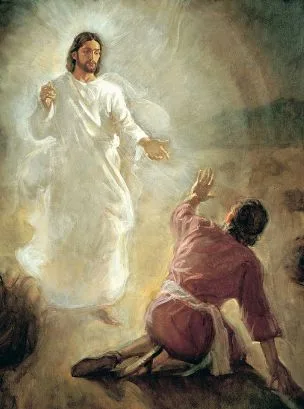
As Saul walks with a small council of servants, guards, and peers, he is struck blind by a burning light and a voice that says, “Saul! Why are you persecuting me?”
“Who are you?”, he asks in astonishment.
“I am the Lord Jesus, whom you are persecuting, but now rise and enter the city and you will be told what to do.”
His fellow travelers heard the voice but did not see the light, yet Saul was now blind. So, they led him by the hand into the city and for three days he was without sight and did not eat or drink.
Then, a faithful man named Ananias from Damascus reluctantly lays his hand on Paul and heals him, and something like scales fell from the eyes of Paul. For the first time in his life, he truly understood God.
Saul then begins to proclaim in the Synagogues that Jesus is the Son of God, the long-awaited Messiah, killed and betrayed by his own people. All who hear him are amazed and ask, “Is this not the man who made havoc in Jerusalem for those who called upon this very name, and has he not come here to bring them bound before the chief priests?”
True to form, the Jews begin another plot to kill Paul, but his disciples take him by night and lower him down the wall in a basket. After about three years, throughout which Paul appears to have been studying in Arabia, he returns to Jerusalem to consult with Peter and James for 15 days about the life, death, person, and resurrection of Jesus, who Paul now calls “The Christ”.
This is not an entirely warm welcome, as Paul’s reputation still precedes him. Although he leaves and returns to Tarsus with the disciples not entirely convinced, and this tension is evidenced throughout the epistles, Peter has a profoundly important vision.
God reveals to him in a dream an image of all kinds of animals, clean and unclean, being lowered on something like a sheet. He is given the interpretation of this dream, meaning that the gentiles can now be entered into the salvation of Jesus Christ along with the Jews.
This is one of the most important revelations of all history, and upon hearing it, Paul now has his life’s mission – to spread this message to the gentiles.
This message reveals God’s cosmic plan of unity and oneness unfolding through the scriptures, brought to life by the great men of faith, and carried out by those with the strength and courage to do his will.
Armed with this new revelation, Peter and the apostles send Barnabas, a faithful and righteous man, up to Antioch to teach the gentile church that was established there. The church at Antioch didn’t follow Jewish customs or culture, and even had a new name for the movement – “Christians”, or “little Christs”.
Barnabas, however, realized that he is out of his element in this environment and stops in Tarsus to recruit Saul, a man who has grown up steeped in Hellenist culture, to help him guide the new church.
Up until this point, Christianity has mainly spread, despite the best efforts of the Sanhedrin and Pharisees, through those who had come to Jerusalem, heard the good news, and gone back home. However, after a year or so of pastoring the church in Antioch, Saul and Barnabas get a divine call to go and preach the message of Christianity and the absolution of sin to gentile cities all around the known world. They attempt to start churches and help them become self-sustaining, so that their churches will grow into a global kingdom. They hope to preach this message as far west as Spain, the edge of the known world at the time.
The impact of this journey cannot be overstated. The company sets sail from Seleucia, a port city in Antioch, and they sail to Cyprus, where they successfully convert a Roman Proctor named Sergius Paulus. Coincidentally, this is where we first learn that Saul has officially changed his name to Paul, perhaps struck by the inspiration that he will be more successful in converting gentiles if he has a name that is more like theirs.
After meeting with much strong opposition in the synagogues, Paul and Barnabas declare that they are giving up on the Jews and will now be spreading and offering salvation primarily to the Gentiles. We read in Acts:
- Then Paul and Barnabas boldly declared, “We had to speak God’s word to you first, but since you reject it and consider yourselves unworthy of eternal life, we are now going to turn to the gentiles. For that is what the Lord ordered us to do: ‘I have made you a light to the gentiles to be the means of salvation to the very ends of the earth.’”
Now, the story of Paul goes on and on, told mainly in Acts, and it is a story filled with adventure, shipwrecks, snake bites, healing, raising people from the dead, and of course, persecution. Written by Luke, Acts represents an excellent piece of history, accurately capturing what life was like in that day.
Colin Hemer was a classical scholar who specialized in New Testament studies. In his book, The Book of Acts in the Setting of Hellenistic History, he carefully evaluates and demonstrates the historicity of Acts in various ways, describing Acts as a “coherent and consistent product of its day”.
Dr. William Lane Craig describes the book as follows:
- Hermer goes through the book of Acts with a fine-toothed comb, pulling out a wealth of historical knowledge, ranging from what would have been common knowledge down to details which only a local person would know. Again and again Luke’s accuracy is demonstrated: from the sailings of the Alexandrian corn fleet to the coastal terrain of the Mediterranean islands to the peculiar titles of local officials, Luke gets it right.
Recently, archeologists believe they have discovered anchors from Paul’s detailed shipwreck account near Malta described in Acts, as reported by the Daily Mail.
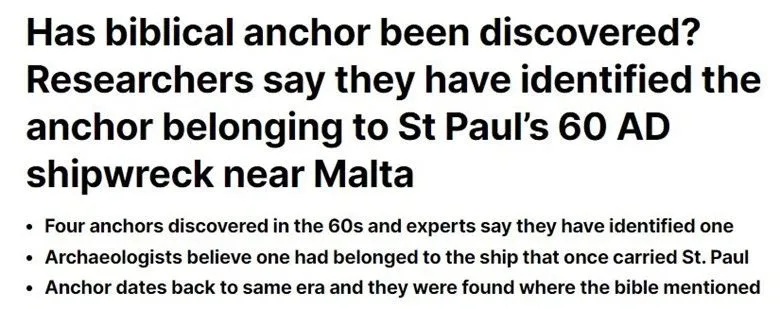
It’s one of the most inspiring stories of all time, and Paul is a legendary Christian that all can learn from and admire. Paul was likely sentenced to death in his old age by the infamous emperor Nero, as part of the great Christian persecution of that era.
Although Paul died a brutal and unjust death, like the other disciples, he lives a great life, and his powerful message reaches out through the halls of Christianity today, standing as perhaps the second-most important figure of all – second only to Jesus Christ himself. Without Paul, the message would never have spread so effectively to the gentiles, and Christianity may have remained a localized movement in Asia Minor and the Middle East.
Paul was the man who brought the message of salvation to the gentiles, and this is his message:
Even though all have sinned and fall short of the glory of God,
The righteousness of God is available through faith in Jesus Christ.
There is now, therefore, no condemnation for those who are in Christ, but in him we have redemption through his blood, the forgiveness of sins, according to the riches of his grace.
The mystery that has been hidden from the ages past and generations has now been manifested to his saints – this mystery is not only that the gentiles are fellow heirs with the Jews, but this Messiah, the Christ, was a suffering servant, rejected by his own, sentenced to die as a common criminal, and forced to endure the worst suffering imaginable.
If then, you have been raised with Christ, seek the things that are above where Christ is seated at the right hand of God, and the God of peace will be with you – for this was the plan for the fullness of time to unite all things in him – things in heaven and things on Earth.
Thanks be to God.
\
What practical advice can we learn from Paul? The one thing that really stands out about Paul was that he was, if nothing else, a worker. He worked his whole life, not only as a Jewish leader, but as a tent-maker to support himself and his travels.
He never relied on donations, free food, or the support of fellow Christians – though he could have. Instead, he worked for himself to pay his own way through life, in order to set an example that we should all follow.
In 1 Thessalonians 4, we read in a section titled, “A Life Pleasing to God”:
- But we urge you, brothers, to do this more and more, and to aspire to live quietly, and to mind your own affairs, and to work with your hands, as we instructed you, so that you may walk properly before outsiders and be dependent on no one.
Furthermore, in 2 Thessalonians, we read in “A Warning Against Idleness”:
- For you yourselves know how you ought to imitate us, because we were not idle when we were with you, nor did we eat anyone's bread without paying for it, but with toil and labor we worked night and day, that we might not be a burden to any of you. It was not because we do not have that right, but to give you in ourselves an example to imitate. For even when we were with you, we would give you this command: If anyone is not willing to work, let him not eat. For we hear that some among you walk in idleness, not busy at work, but busybodies. Now such persons we command and encourage in the Lord Jesus Christ to do their work quietly and to earn their own living.
This is one of Paul’s most important lessons – the Christian should always work, always support themselves, and not be a burden on others. Be busy, not busybodies.
While Paul teaches many lessons and sets many examples, this is a good practical place to start when studying the life of Paul the Great Apostle.
Take it to heart.